

Let US Vote:
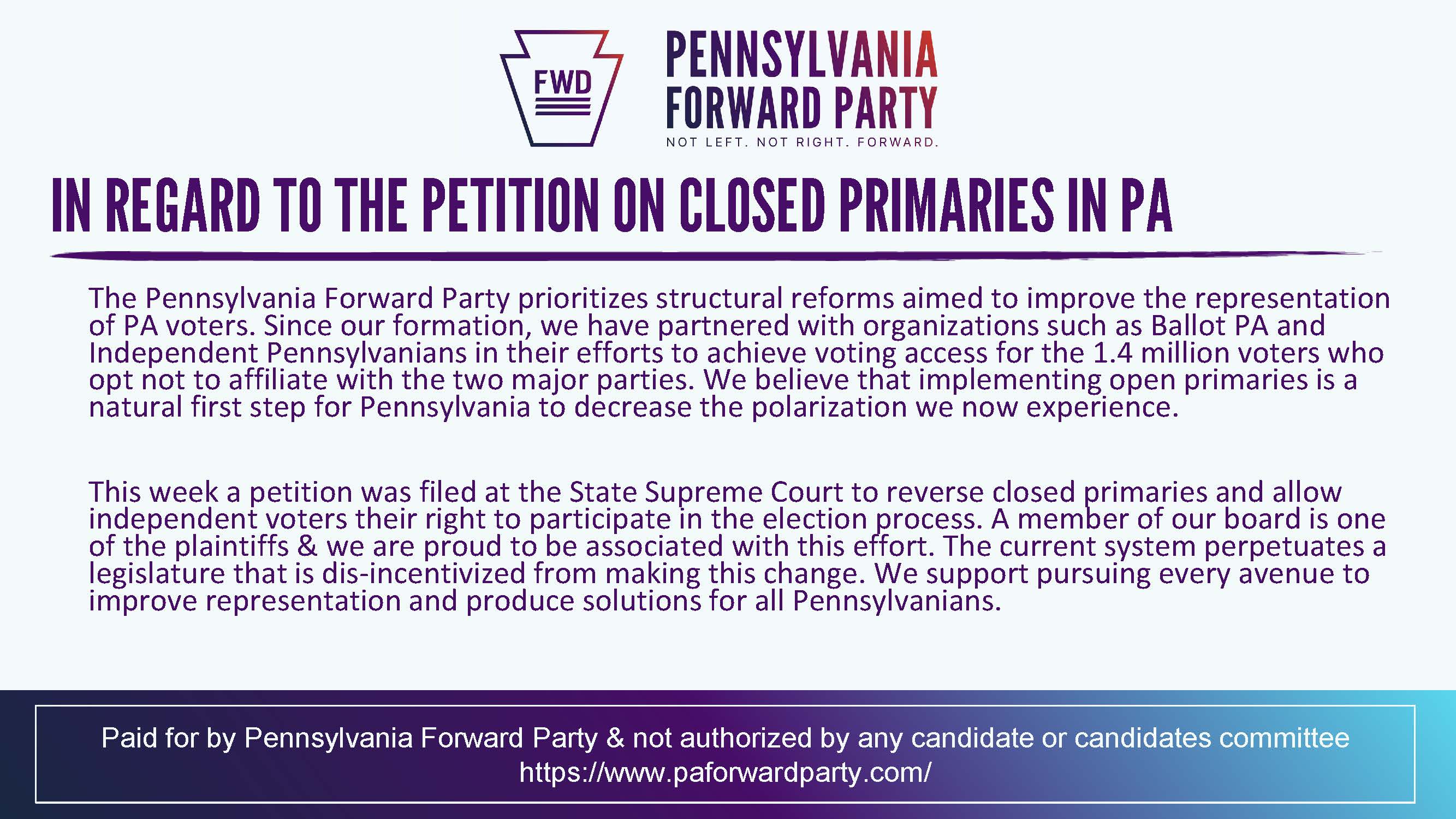
Earlier this week, a petition was filed at the State Supreme Court to reverse closed primaries and allow independent voters their right to participate in the election process. A member of our board, Rachel Shanok, is one of the plaintiffs. The Pennsylvania Forward Party is proud to be associated with this effort. The current system perpetuates a legislature that is dis-incentivized from making this change. We support pursuing every avenue to improve representation and produce solutions for all Pennsylvanians.
This petition seeks that the Pennsylvania Supreme Court exercise its King’s Bench power to immediately see the case. Unlike the United States Supreme Court, the high court in Pennsylvania has the option to immediately intervene in any case when there is an issue of high public importance. This power originated from English Common.
You can also view the announcement here: Smerconish
From the Petition:
Petitioner Rachel Shanok is a resident of Ambler, Pennsylvania. She is employed as a physical therapist. In addition to her professional employment, Ms. Shanok is an active member of Forward, a political organization committed to interjecting “new ideas and new debates” into our political discourse. Ms. Shanok is an independent voter for political and community reasons. Ms. Shanok, who was formerly registered as a Democrat, believes that neither the Democratic nor Republican parties as institutions appropriately reflect her political views. Ms. Shanok also believes that party registration requirements have contributed to the hyper partisanship which has infected our political discourse and is particularly corrosive at the local and municipal level, where she feels that her decision to affiliate or not affiliate with a political party may be an obstacle to serving her community, whether elected or appointed.
In 1937, the Legislature enacted sweeping changes in the electoral system. This was the first overhaul of its election system in roughly a century. The 1937 overhaul established the fundamentals of the Election Code as it exists today. Apart from establishing the powers and duties of state and county officials in administering elections, the 1937 overhaul included provisions outlining voter qualifications…There is no indication that the General Assembly considered independent voters, who composed only 3% of the electorate at the time.
[I]ndependent voters are denied any meaningful role in the nominating process. They cannot sign a nominating petition for a candidate seeking the nomination of a political party. They cannot nominate a candidate by an ordinary vote. They cannot nominate a candidate by a write-in vote. The only role independents can play in the nominating process is to sign the petition of an “independent” candidate. By virtue of Section 2812, independent voters have no ability to turn their support for any candidate except an independent candidate into an actual nomination. Under Section 2812, independent voters’ right to vote at the primary stage is not just diluted. It is evaporated.
At the local level, candidates are permitted to cross-file for positions like school director. They can win both the Democratic and Republican nominations for the position. That these candidates can appear on both primary ballots would suggest the intent that these races should be less subject to partisanship and party preference. But independent voters (who are by definition less partisan) cannot vote in these cross-filed primary elections either. By the time independent voters cast their votes in the fall, the election is frequently already over as a practical matter.




Showing 1 reaction